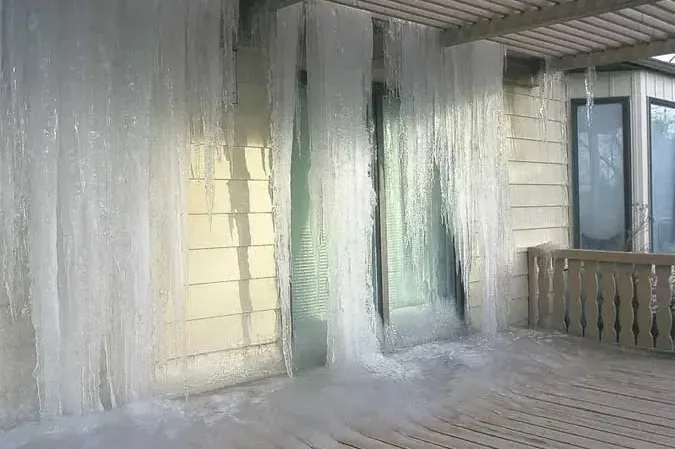
A Kroh Brothers housing development led to Leawood's incorporation on November 30, 1948, and subdivision language for Leawood Estates had been filed more than three years earlier. In neighborhoods with roots that far back, original supply pipes can still run through walls, which makes fall the right time to check them.
Key takeaways
- Pipes freeze where cold air reaches them: exterior walls, unheated garages and utility spaces, attics and outdoor hose bibs.
- A frozen pipe often causes damage only when it thaws and splits, so the leak can start after the cold snap eases.
- Disconnecting hoses, insulating exposed pipes and knowing the main shutoff are fall jobs that take an afternoon.
- Moisture mapping finds how far thaw water traveled inside walls and ceilings before the wet cavities are opened and dried.
- Houses left empty for days need steady heat and someone to check them on cold nights.
Why fall is the time to check
Owners in Hallbrook, South Lake, Ironwoods Park and other neighborhoods cannot see inside their walls, so the pipe material and route in each house are worth confirming.
Autumn is calm weather for plumbing work and insulation. Once a hard freeze arrives, a split pipe may already be in progress.
Where pipes freeze first
Exterior walls and hose bibs
A pipe on the cold side of the insulation, or in a wall with gaps, loses heat first. Outdoor hose bibs freeze when a hose stays attached, because the trapped water has nowhere to go.
Unheated spaces
Garages, attics and utility rooms outside the heated part of the house hold pipes that nothing warms. Pipes along an exterior wall under a sink are another common spot.
Water spreading right now? Shut off the main if it is safe. The restoration team extracts, dries to the IICRC S500 goal and documents every step, 24/7.
Reach the drying team for your homeA room by room walk-through
Kitchen and bath
Sink cabinets on exterior walls are classic trouble spots, because the supply pipes sit against the coldest surface in the room. The dishwasher and ice maker supply pipes are worth a look too.
Laundry and mechanical rooms
Washer hookups, water heater connections and utility sinks often sit in rooms that are heated lightly or not at all. A glance at insulation and drafts there pays off.
Garage and attic
Any supply pipe that runs through a garage wall or an attic needs insulation and a way to stay warm. Gaps around pipe penetrations let cold air in and are easy to seal.
Know what the pipes are made of
Houses of any age can have copper, plastic or older metal supply pipes, and the material changes how a freeze plays out. Copper tends to split at the point where ice forms, plastic can crack at fittings, and older metal pipes can fail at corroded joints.
A plumber can identify the material during a routine visit, and the answer helps decide where insulation matters most.
A fall checklist
These steps take an afternoon, and a few of them stop the start of frozen pipe water damage.
- Disconnect and drain garden hoses, and shut off and drain outdoor spigots where the system allows it.
- Insulate exposed pipes in garages, attics and utility spaces.
- Seal gaps where pipes enter an exterior wall.
- Find the main water shutoff and make sure it turns.
- Open the cabinet doors under sinks on cold nights.
- Keep the heat on, even in rooms that are rarely used.
What to do when a pipe freezes but has not split
Acting before the split is the best case. A pipe that is frozen but intact can often be thawed without any water damage.
- Open the nearest faucet slightly so melting ice has a path to flow.
- Apply gentle warm air with a hair dryer, working from the faucet toward the frozen section.
- Never use an open flame, which can ignite framing and crack the pipe.
- Stay nearby while the pipe thaws, and watch for drips or sprays.
- Shut off the main and bring in a plumber if the frozen section is hidden or leaking.
What a frozen pipe does when it thaws
Ice expands inside a pipe and can crack it, but the crack often stays sealed by ice until it thaws. The water then flows out into the wall, ceiling or floor.
A small split can run for a long time inside a wall, and a burst pipe water damage job often starts with a stain, a damp smell or a drop in water pressure.
- Water stains on a ceiling or wall.
- A musty smell near an exterior wall.
- The sound of running water with every fixture off.
- A faucet that gives only a trickle on a cold morning.
What to do when a pipe splits
A split pipe releases water under pressure, so the shutoff is the first move and everything else follows it.
- Shut off the water at the main.
- Open faucets on the lowest level to drain the system.
- Switch off power to wet areas only if the panel is dry and safe to reach.
- Move belongings out of the wet area and photograph the damage.
- Bring in a plumber for the repair and the restoration team for extraction and drying.
Finding, opening and drying
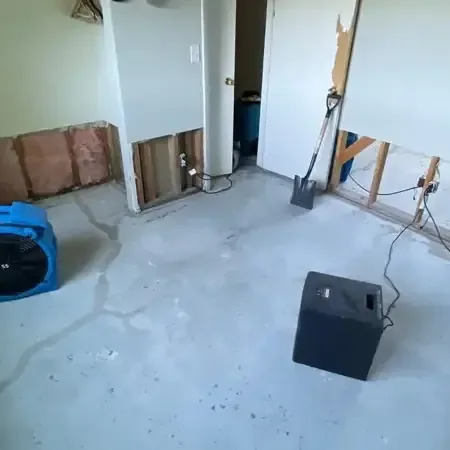
Moisture mapping with meters shows where the water went, which is often farther than the visible stain.
The mitigation team extracts standing water, opens the wet cavity and removes wet insulation. Structural drying equipment then works until readings match a dry reference, and the drying time estimator gives a rough sense of how long that can take.
When the house sits empty
Travel, a second home or a relative's house left alone can turn a small split into a large loss.
A small split can run for days in an empty house, and by the time someone arrives the water may have soaked floors, walls and the ceiling below.
- Keep the heat on at a steady, moderate setting.
- Ask a neighbor to look in on cold days.
- Know where the main shutoff is, and shut it off for long absences.
- Leave cabinet doors open under sinks in exterior walls.
Questions
At what temperature does a pipe freeze?
Water freezes at the freezing point, and a pipe in an unheated space can reach it when the air outside stays cold for a stretch. Wind and gaps in an exterior wall speed it up.
Is a frozen pipe the same as a burst pipe?
No. A frozen pipe is blocked by ice, and a burst pipe is cracked. Many pipes freeze without bursting, but the split often shows only after the thaw.
Should a frozen pipe be thawed with a torch?
No. An open flame can ignite framing and can crack the pipe. Gentle warm air and slow thawing are safer, and a plumber is the right choice when the pipe is hidden.
How are hidden leaks found?
Moisture meters and thermal imaging trace water behind walls and above ceilings, which lets the team open only the section that is wet.
Do hose bibs really matter?
Yes. A hose left on a spigot traps water that freezes and splits the pipe behind the wall, and the leak runs inside the house once the weather warms.
Does homeowners insurance cover thaw damage?
Many policies cover sudden pipe breaks, but they may limit coverage when a house was left unheated for a long time. The policy wording and the cause of the loss decide, so photos and a repair record help.